New Grant for Gesture Control of Smart Homes

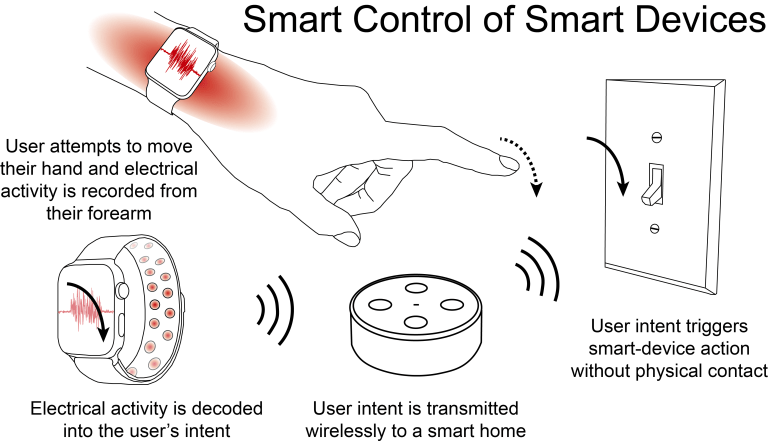
The Utah NeuroRobotics Lab was just awarded $200,000 to develop a wearable device capable of translating intended movements of the hand into control of smart-home devices. The funding comes from the Veterans Affairs "Specially Adapted Housing Assistive Technology" program. The long-term vision of this project is to allow individuals with neuromuscular impairments the ability to seamlessly interact with their home environment, despite physical limitations and/or impaired speech. The wearable device, in the form of a wrist watch, will use electromyography and various embedded sensors to determine a users intended hand gestures, even if they are weak or unable to physical move their hand. This fast-paced 1-year project will run from June 2022 to June 2023 and result in a functional prototype and leverage plan for future commercialization of the assistive technology.

You can learn more about the grant here: https://www.ece.utah.edu/2022/08/25/george-receives-200k-grant/

New Grant from Utah PIVOT Center!

The Utah NeuroRobotics Lab was recently awarded a $96,500 grant from the University of Utah's Partners for Innovation, Ventures, Outreach and Technology (PIVOT) Center. This grant will help out lab bridge the funding gap between research and commercialization by providing support for technology development, proof of concept, and to prepare the innovation for additional investment by entrepreneurs, investors, and potential licensees. Specifically, the objective of this grant is to demonstrate the feasibility of expanding our brain-computer interface technology into the broader Internet-of-Things market. We will transition our technology from a rough prototype used to control prostheses/orthoses into a sleek product resembling a smartwatch and capable of controlling numerous smart-home devices simply by thought. You can learn more here.

New Grant from Facebook Reality Labs!

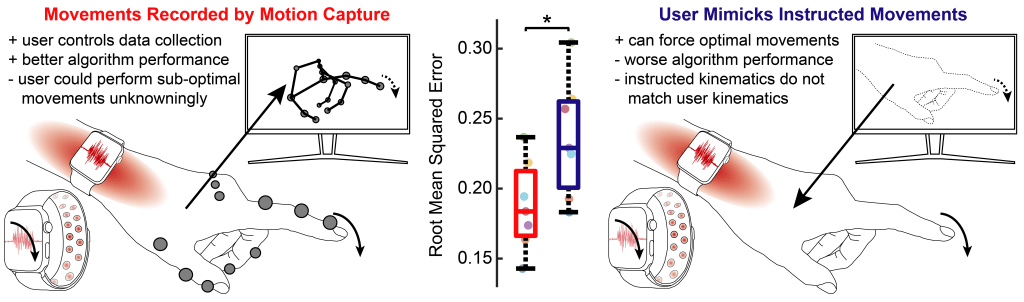
The Utah NeuroRobotics Lab was recently awarded a $150,000 grant from Facebook Reality Labs to develop new inclusive neural interfaces for controlling virtual and augmented reality. We were one of six selected for funding out of 50 applications! The objective of our proposal is to develop a privacy-by-design EMG data-collection process that provides unbiased and generalizable performance across different decode algorithms and users’ physical ability levels. To maximize EMG privacy, we will place users in direct control of the data-collection process and allow them to rapidly collect data that is inclusive to their specific needs on an as-needed basis. We will also identify key aspects of training data that are critical for unbiased run-time performance in order to inform users how to maximize performance and minimize data collection. Experimental changes in the data-collection process will be validated with functional and psychological metrics while users complete activities of daily living (ADLs) in a virtual reality environment (MuJoCo HAPTIX) with different decode algorithms. Importantly, validation will be done with participants exhibiting common neuromuscular disorders to ensure that the technology is inclusive to individuals with varying physical ability levels.

You can learn more about the grant from Facebook Reality Labs and from the University of Utah Department of Electrical & Computer Engineering!

NeuroRobotics Lab Awarded NVIDIA Jetson Nanos!

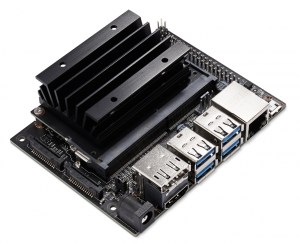
Dr. George was recently awarded a grant from NVIDIA to supply Jetson Nanos for the NeuroRobotics course! A Jetson Nano is a small, powerful computer (similar to a Raspberry Pi) with an embedded GPU to run multiple neural networks in parallel for applications like image classification, object detection, segmentation, and speech processing. It's an easy-to-use platform that runs in as little as 5 watts. These new modules will allow for a variety of deployable AI models for decoding biological signals (to control bionic devices by thought) and encoding neural stimulation (to provide haptic feedback or to animate limbs). Read more about the award here.