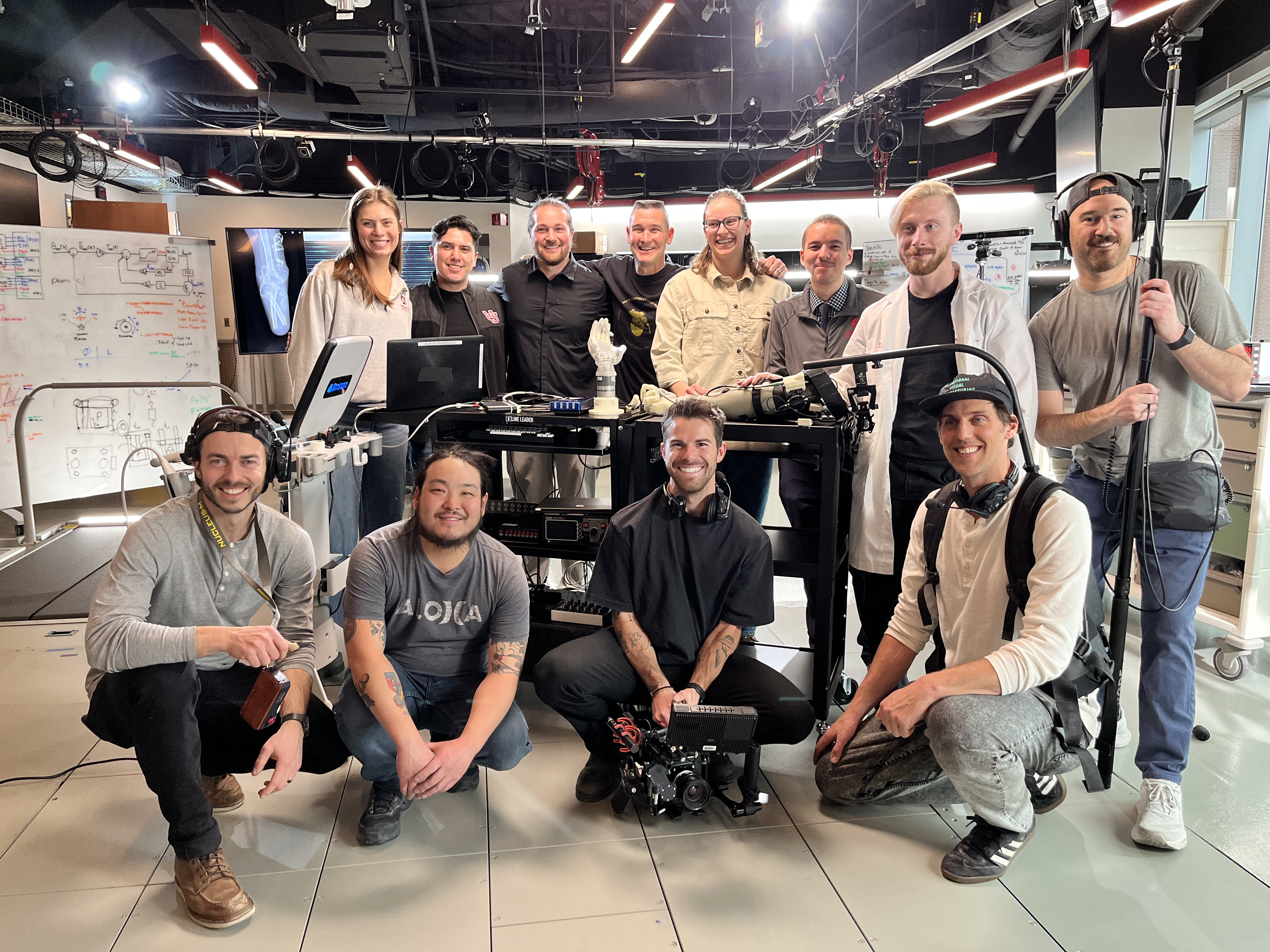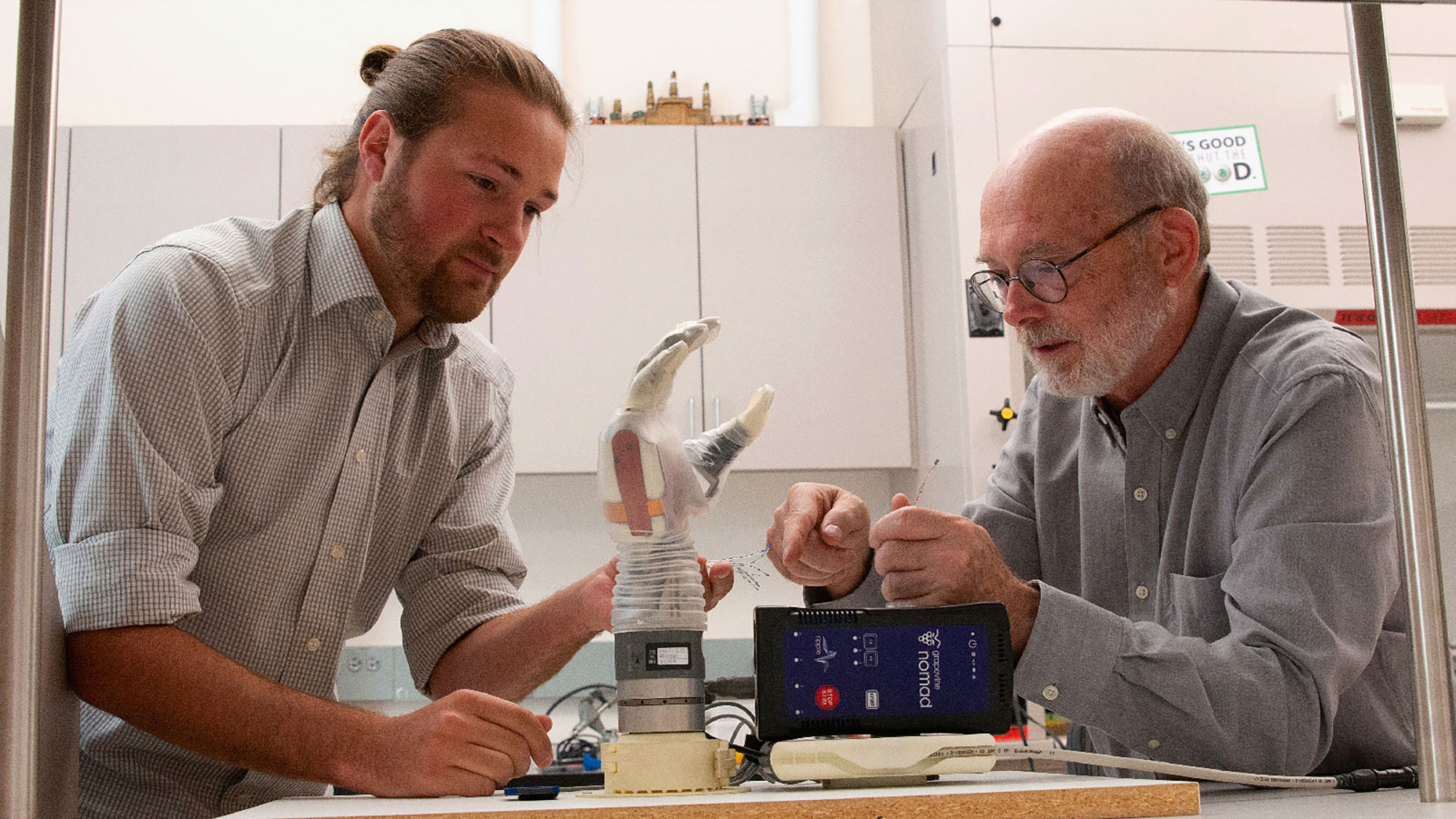
New publication in the Journal of NeuroEngineering and Rehabilitation!

A paper led by Caleb Thomson was recently published in the Journal of NeuroEngineering and Rehabilitation. The paper is titled: “Proportional myoelectric control of a virtual bionic arm in participants with hemiparesis, muscle spasticity, and impaired range of motion” and was coauthored by Fredi R Mino, Danielle R Lopez, Patrick P Maitre, Steven R Edgley and Jacob A George.

This project investigated the ability of stroke patients with hemiparesis to use proportional myoelectric controls.

LinkedIn Post

Link to Paper

New publication in the Journal of Neural Engineering

A paper led by Caleb Thomson was recently published in the Journal of Neural Engineering. The paper is titled: “Enhancing neuroprosthesis calibration: the advantage of integrating prior training over exclusive use of new data” and was coauthored by Troy N Tully, Eric S Stone, Christian B Morrell, Erik J Scheme, David J Warren, Douglas T Hutchinson, Gregory A Clark and Jacob A George.

LinkedIn Post

Link to Paper

Dr. Jacob George featured as expert in article discussing spinal cord stimulator

A recent article by Luisa Torres, PhD, in Drug Discovery News featured Dr. Jacob George in a discussion about the use of spinal cord stimulators in patients with lower-limb amputations. A recent Nature Biomedical Engineering study used spinal cord stimulation to restore the sense of touch, improve balance, and reduce phantom limb pain in patients with amputation below the knee. Dr. George discussed the benefits and use of such technology as an industry expert in response to this study. The full article can be read here.

Dr. George Presents at Vitae!

Dr. George presented at the Vitae event today. Vitae is a hallmark event recognizing research excellence across University of Utah Health. This year Vitae celebrated six rising-star faculty who are on the forefront of their professions as they shared stories of their science and how they got to where they are today. Vitae annually highlights investigators and their pioneering research programs. The program seeds new
collaborations and development strategies by humanizing research through story. The Vitae annual symposium is presented by Vice Chair for Faculty Affairs and Development, Department of Internal Medicine, and Michael Rubin, MD, PhD, on behalf of the Office of the Associate Vice President for Research.

Myoelectric Controls Symposium 2022

The first in-person conference for our lab was a huge success! Our Lab had four podium presentations and two posters at the Myoelectric Controls Symposium (MEC) in New Brunswick, Canada. We took home both 1st and 2nd place student awards! We’re very proud of all our students and their hard work!

MEC is a mix of researchers, companies, patients, therapists, and clinicians dealing in upper-limb prosthetics, and it is always an enjoyable conference! Special thanks go to the University of New Brunswick (UNB) for hosting the conference!

Click here to view the conference proceedings

Research Featured in National Geographic Cover Story

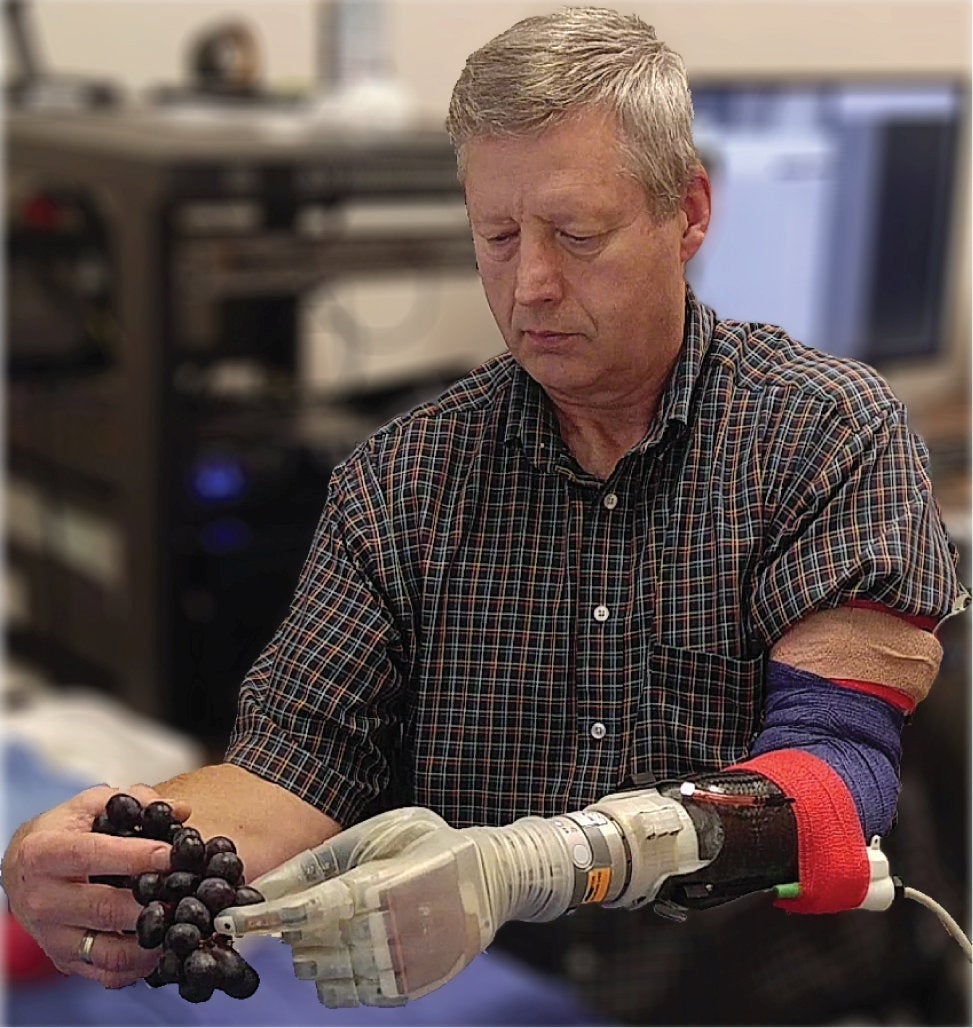
Research from Dr. George, in collaboration with Dr. Clark, was recently featured in June Cover Story of National Geographic. The cover story, titled, "The Power of Touch," highlights several ongoing research studies that seek to restore the sense of touch to individuals who have lost it. The U's research on the "LUKE Arm" is among the research studies featured. An excerpt from the article is listed below:

..."I just wanted to see if I could pay it forward," said Keven Walgamott, a Utah real estate agent who lost parts of his right arm and foot two decades ago after a power line sparked while he was lifting a pump out of a well outside his home.

Starting in 2016, Walgamott spent more than a year as a research volunteer at the University of Utah, where he was temporarily implanted with electrodes, including some developed by scientists there. Inside their lab, wired into a computer, Walgamott would put on one of the new sensorized prostheses--this one named the LUKE, for Life Under Kinetic Evolution but also for Luke Skywalker, the Star Wars Jedi who loses his hand in a light-saber fight with Darth Vader. By the end of The Empire Strikes Back, Luke has a prosthetic that can apparently do everything, including feel. If you enter "Walgamott eggs" or "Walgamott grapes" into a search engine, you'll see him in a Utah lab with the LUKE: Concentrating, his face sober, he's performing the kind of simple tasks that are almost impossible for hands that can't feel.

He lifts a raw egg in its shell, with just the right delicacy, and sets it gently into a bowl. He holds a grape cluster with his actual hand, closes a prosthetic thumb and finger around a single grape, and pulls it off without squashing it...

New Manuscript on Robust Thought-Controlled Exoskeletons

Our work on robust thought-controlled exoskeletons in collaboration with the Utah Bionic Engineering Lab is now published online in Frontiers in NeuroRoboticsWe explored how a powered hip exoskeleton impacts muscle activity, and the implications of that on real-time EMG control. We showed that lower-limb and lower-back muscle activity change non-linearly as a result of increasing exoskeleton assistance - this makes real-time EMG control difficult because the act of controlling (assisting) changes the input signal. The good news is that nonlinear neural networks are capable of generalizing predictions of torque across different levels of exoskeleton assistance, when explicit training data is provided. However, a common linear model (i.e., a Kalman filter) is not capable of the same generalization. Lastly, given that explicit training data on every level of exoskeleton assistance may not be feasible, we show that, when time is limited, training data for EMG control of exoskeletons should use at least 35 gait cycles and emphasize the highest levels of assistance first! The full article is available open-access here: https://doi.org/10.3389/fnbot.2021.700823