Reflecting on the Utah Neurotech Showcase | February 2026

What an incredible evening. Utah NeuroRobotics Lab had the opportunity to participate in the University of Utah’s Neurotech Showcase — a night dedicated to bringing together the brightest minds in neurotechnology: researchers, industry leaders, investors, and policymakers, all under one roof.

We got to show the world what we’ve been building. Check out the recap below.

Utah NeuroRobotics Lab Featured in $100M Research Investment Story

A huge shout-out to Fredi, Marshall Trout, Leonardo, and Caden Hamrick for representing the lab and showcasing our research to state legislators at the Utah Higher Education Appropriations Committee Meeting last week!

Their efforts clearly made an impression — our lab is featured on the front page of a recent article detailing Utah’s plans to invest $100 million into university research. It’s incredibly exciting to see our work recognized at the state level, and a testament to the passion and dedication this team brings to every opportunity.

Thank you all for representing the Utah NeuroRobotics Lab so well. Way to go, team!

🔗 Read the full article at @theU

NeuroRobotics Lab Partners with Meta to Advance Accessible Wearable Technology for People with Limited Hand Mobility

The Utah NeuroRobotics Lab, led by Dr. Jacob A. George, has launched a new research collaboration with Meta to evaluate how consumer-grade wrist wearables can make human-computer interaction more accessible for people with varying levels of hand mobility. Building on previous research that demonstrated how surface electromyography (EMG) signals remain viable for control even with reduced signal-to-noise ratios, Dr. George’s team will now assess Meta Neural Band technology with end users who have neuromuscular conditions. The research will examine how EMG-based gesture controls can enable individuals to operate computers, smart home devices, and potentially recreational mobility equipment like the University of Utah’s TetraSki. This collaboration emphasizes co-design with end users to ensure the technology meets diverse needs and can be customized for people with conditions such as muscular dystrophy, stroke, spinal cord injury, ALS, and limb loss.

Learn More: Read the full article on Meta’s blog: A Look at the University of Utah’s Accessibility Research Using Meta Neural Band

Nature Communications paper hits major global impact milestone

Congratulations to Marshall Trout and co-authors Fredi, Connor Olsen, Taylor Hansen, and David J. Warren on their recent publication in Nature Communications.

The paper has already received significant global visibility, including:

  • Altmetric score: 813 (99th percentile; top 5% of all research outputs tracked)

  • 143 unique news stories, syndicated across 500+ outlets

  • Estimated reach of 406,729 unique viewers

Read the Altmetric report: Click Here
Paper: Shared human-machine control of an intelligent bionic hand improves grasping and decreases cognitive burden for transradial amputees

New Nature Communications paper highlights smarter, more intuitive bionic-hand control

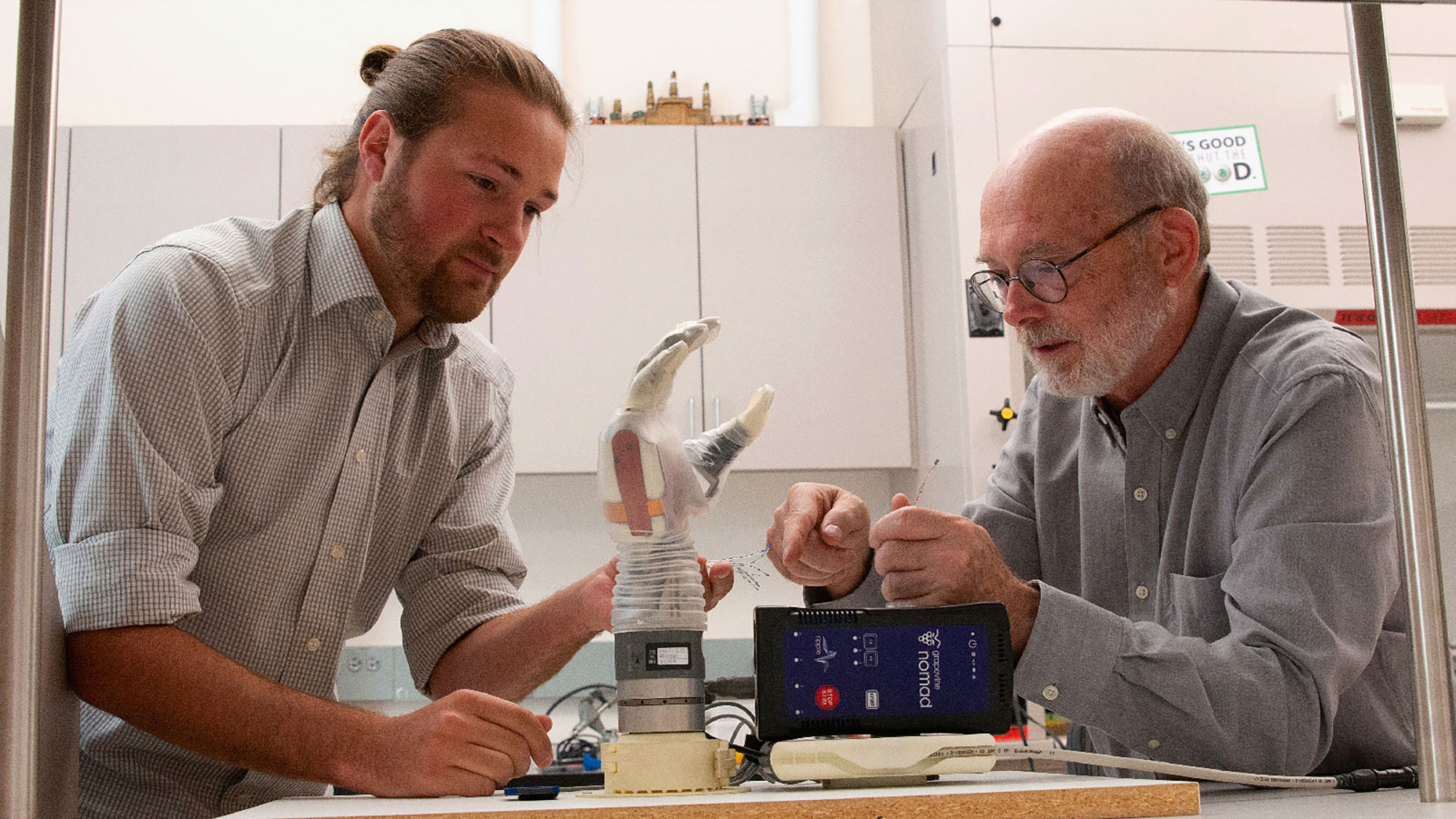
A University of Utah team led by Marshall Trout and Jacob A. George published a new paper in Nature Communications demonstrating shared human–machine control for a commercial bionic hand. By integrating proximity + pressure sensing and using AI to help each finger “find” contact automatically, users can maintain control while the hand handles the fine-grain adjustments—resulting in more secure, more precise grasps with lower cognitive burden.

Read the paper

As of Jan 13, 2026, the paper has an Altmetric attention score of 814.

BIOS Honored in Utah Business Innovation Awards

Biologic Input Output Systems (BIOS), a startup spun out of the Utah NeuroRobotics Lab, has been recognized as an Emerging Company in the Healthcare & Life Sciences category of the Utah Business Innovation Awards. The company’s Universal Neural Interface builds intuitive connections between the brain and advanced robotics to help people with limb loss regain natural movement and sensation, translating decades of University of Utah research into real-world impact. Read more about BIOS and the three University of Utah startups honored in this year’s awards here. 

BioHive Features BIOS–U of U Collaboration on Bionic Sensation

BioHive recently highlighted Jacob A. George, Chief Scientist at Biologic Input Output Systems (BIOS), discussing how their Universal Neural Interface is helping people with limb loss regain both movement and real, emotional sensation—often for the first time in decades. In a recent LinkedIn post featuring a video interview, BioHive showcases how BIOS is working with the University of Utah and the NeuroRobotics Lab to engineer advanced prosthetic limbs that reconnect patients with the world around them.

AI & Bionics: Utah NeuroRobotics Lab Featured in U of U AI Story

The University of Utah’s Office of Artificial Intelligence recently highlighted the Utah NeuroRobotics Lab for its groundbreaking work using AI to design bionic devices that restore movement and sensation for people with neuromuscular impairments. Led by Solzbacher-Chen Endowed Professor Jacob A. George, the lab bridges engineering, medicine, and advanced AI to create prosthetic and assistive technologies that improve independence and quality of life. Read the full feature here.