BIOS Named 2025 Innovation Awards Honoree

We’re proud to announce that BIOS, a company that spun out of our lab, has been named an Emerging Honoree in the Healthcare & Life Sciences category of the 2025 Utah Business Innovation Awards. This annual recognition celebrates the groundbreaking companies and technologies shaping Utah’s future — and BIOS’ inclusion highlights how research born in our lab is transforming lives beyond the university walls.

BIOS is pioneering a Universal Neural Interface that intercepts, captures, and edits neural signals — creating a bridge between the human nervous system and advanced prosthetic devices. This breakthrough technology addresses a critical challenge in prosthetic adoption: many users abandon devices due to limited control or lack of sensory feedback. BIOS’ innovations are designed to change that, making prosthetics that move and feel like a biological limb.

The company’s recognition is more than just an award — it’s a testament to the power of research translation and the impact of collaborative innovation. What began as an ambitious idea in our lab has grown into a technology with the potential to transform the lives of people with limb loss and neurological conditions.

We congratulate the BIOS team on this well-deserved honor and look forward to continuing our shared mission of advancing human-machine integration to improve quality of life.

🏆 Read the full announcement on Utah Business.

Dr. Jacob George Honored at U of U Health Celebrates Distinction 2025

We are proud to celebrate Dr. Jacob A. George, Assistant Professor of Electrical & Computer Engineering and Physical Medicine & Rehabilitation, who was recognized as a current endowed chair holder at the 2025 U of U Health Celebrates Distinction event.

Dr. George holds the Solzbacher-Chen Endowed Chair in the Department of Physical Medicine & Rehabilitation and the Department of Electrical & Computer Engineering — a distinction that honors his pioneering work at the intersection of rehabilitation robotics, sensorimotor neural engineering, and bioinspired artificial intelligence

His research focuses on developing advanced neural interfaces and prosthetic technologies that restore movement and sensation to individuals with limb loss or neurological conditions. This work is a driving force behind the development of cutting-edge systems like the LUKE arm and has also led to the creation of BIOS, a company spun out of our lab that was recently named an Innovation Awards honoree by Utah Business.

Through his leadership and groundbreaking research, Dr. George is helping redefine wha t’s possible at the intersection of engineering, neuroscience, and patient care — improving quality of life and expanding the future of neurotechnology.

Dr. George Appointed Solzbacher-Chen Endowed Professor

The University of Utah’s John and Marcia Price College of Engineering has announced the appointment of Dr. Jacob A. George as the new Solzbacher-Chen Endowed Professor in Electrical & Computer Engineering (ECE) and Physical Medicine & Rehabilitation (PM&R). This prestigious appointment marks a significant step in advancing the university’s commitment to interdisciplinary research and innovation at the interface of neural engineering and biomedical technology.

An endowment is a permanent fund established to provide ongoing financial support for specific academic initiatives or positions. The Solzbacher-Chen Endowed Professorship is particularly prestigious as it not only honors Dr. George’s exceptional achievements but also underscores the lasting investment in the fields of neural engineering and rehabilitation, ensuring continuous growth and development for years to come.

Florian Solzbacher, the Gerald and Barbara Stringfellow Endowed Professor in the Department of ECE, and Xiaoxin Chen, CEO of the Utah-based biotech startup Sentiomed Inc., were instrumental in establishing this endowment. Both Solzbacher and Chen have made groundbreaking contributions to neural engineering, and their vision of using advanced technologies to restore lost function due to injury or disease forms the cornerstone of this new initiative.

Solzbacher’s pioneering work in developing the Utah Electrode Array, a brain-computer interface that is widely considered the gold standard for restoring lost brain function, alongside Chen’s advancements in biocompatible hydrogel-based technologies, has provided the foundation for this important collaboration. Chen’s work with Sentiomed, which includes the development of implantable biomarker sensors, intracranial pressure sensors, and devices for optogenetics research, adds a critical dimension to the university's ongoing efforts in brain-computer interface research and neural restoration technologies.

Dr. George’s appointment comes after years of dedication and achievement. Under Solzbacher’s leadership as Chair of ECE, Dr. George played a key role in establishing the first alliance between the Department of Electrical & Computer Engineering and the Department of Physical Medicine & Rehabilitation at the Spencer Fox Eccles School of Medicine. This groundbreaking collaboration has set the stage for Utah to become a global leader in neural engineering and brain-computer interface development.

The Solzbacher-Chen Endowed Professorship reflects a deep investment in Dr. George’s research and mentorship, which promises to inspire future generations of engineers, medical professionals, and researchers. In his thank-you speech, Dr. George shared, “I’m incredibly honored and humbled to be selected for this prestigious endowment. It’s a testament to the collaboration and support I’ve received from my mentors, colleagues, and students here at the University of Utah.”

His work is poised to make lasting impacts on the restoration of neural function and the improvement of quality of life for patients facing life-altering conditions. "I look forward to growing our neuroengineering program and continuing the incredible work we’re doing here in Utah," Dr. George added. "Together, we will advance the field, ensuring that the technologies we develop benefit patients and improve healthcare outcomes."

Through this appointment, Dr. George is expected to continue advancing the university’s standing in the fields of neural engineering, brain-computer interface technology, and rehabilitation medicine. Both Solzbacher and Chen emphasized their gratitude for the continued support of the Price College of Engineering and the University of Utah, with an eye toward a future where interdisciplinary collaboration leads to innovative solutions for the most pressing medical challenges.

This new chapter in Dr. George’s career not only elevates his personal achievements but also strengthens the University of Utah’s position as a world leader in neural engineering and rehabilitation research.

UROP Awards for Spring 2025

Huge congratulations to Ava Lloyd, Luke Jones, and Lily Nygard for their UROP Proposals being accepted and funded for the Spring 2025 semester! The Utah Undergraduate Research Program (UROP) funds students for up to two semesters of research. Each of these students submitted a project proposal under the direction of graduate and faculty mentors.

Ava is working in collaboration with an OT in the NRH to develop a walking aid for patients to use with parallel bars during gait rehabilitation.

Luke is working with MDs in the Emergency Medicine department to develop a sensorized glove to detect and prevent frostbite.

Lily is working to investigate the effects of electrical stimulation on upper-limb spasticity after a stroke!


Dr. Jacob George awarded Outstanding Teaching Award from the College of Engineering

Last week, I was awarded the Outstanding Teaching Award from the College of Engineering! This is a pretty big win since I was up against faculty of all ranks, many of whom have been teaching for a lot longer than I have been.

What I’ve learned is that teaching is hard! It really takes a village to deliver a quality learning experience, especially in a new area like neurotech where there are no textbooks or standardized lab equipment. This award is really a reflection of the village that makes my courses possible. This includes:

  • Caleb Thomson, as the initial TA for my NeuroRobotics Class who did a TON of legwork to get all the labs started.
  • Fredi Mino, who took as TA and continued to improve the labs in lots of exciting ways.
  • Marshall Trout, who developed the hardware that makes the stimulation labs possible.
  • Abby Harrison and Clay Stanley, who have taken up the mantle to continue supporting the stimulation hardware.
  • Connor Olsen, who lead the development of my undergraduate Robotics class and served as an award-winning TA.
  • Marta M. Iversen, who has been an excellent teaching mentor and sounding board for countless ideas and challenges.
  • Abby Citterman and Connor Olsen, for writing letters of recommendation for my application to this award.
  • Many others who volunteer their time each semester to help grade and/or serve as an extra hands-on deck to support the labs and final projects in both classes.
  • And all of my students who have likely taken one of my classes at some point, supporting their enrollment and growth, and providing the critical feedback to improve the course. Oh, and the good course evaluations definitely help!

Thank you all for your contributions to this great achievement. It’s been a fun teaching journey, and I look forward to more exciting things to come with the new courses we’re developing next to support the new neurotech program.

-Dr. Jacob George

Clay Stanley awarded the NIH fellowship

University of Utah Electrical engineering Ph.D. student Clay Stanley received a $144,000 two-year fellowship from the National Institute of Health for individuals with a disability. These funds will support Stanley as he continues his research on non-invasive transcutaneous functional electrical stimulation.

Stanley learned about the NeuroRobotics lab from the family member of a previous inpatient of the Neilsen Rehabilitation Hospital (NRH), where the NeuroRobotics lab is located.  The lab is run by assistant professor Jacob George, who mentors dozens of students on projects for neurorobotic technology. The majority of these projects focus on the advancement of rehabilitation technology for amputees, stroke, and spinal cord injury survivors.

After a traumatic spinal cord injury (SCI) in 2011, Stanley credits improvements in his recovery to extensive physical and occupational therapy research programs established by the NeuroRecovery Network (NRN). In 2015, he participated in an NRN program that used an FES algorithm with positive results on SCI patient rehabilitation outcomes.

One of the senior Ph.D. students in the lab, Marshall Trout, has worked on the development of new FES technology as one of his research aims. Stanley has continued the work of one of these projects that deals with the use of a multi-electrode stimulator to activate the paretic hand of individuals with neurological impairments of the upper extremity.

Modern FES systems can activate paretic muscles, however there is difficulty in activating the muscles in a way that can help patients make functional movements. The two years of funds from the NIH can support Stanley as he pursues his research aim of improving FES therapy for rehabilitation. His goal is to improve FES devices to better assist patients in rehabilitation with more effective hardware, software, and algorithm designs.

Abby Citterman receives O&P Foundation Chester Haddan Scholarship

The Orthotics and Prosthetics Foundation for Education and Research with the American Board for Certification in Orthotics, Prosthetics, and Pedorthics (ABC) offer a scholarship to support individuals pursuing a clinical Master’s degree in orthotics and prosthetics (O&P). Research fellow Abby Citterman has been awarded the Chester Haddan Scholarship for 2024, which includes a $2,500 cash award.

“Abigail is a recent graduate of Northwestern University Prosthetics-Orthotics Center, an incoming NCOPE resident with Gillette Children’s, and a research fellow with the Utah NeuroRobotics Lab, developing and validating novel rehabilitative technologies for individuals with neuromuscular disabilities. She has a specialized interest in the convergence of neural engineering, O&P, and design. Abby is especially passionate about helping bridge the gap between cutting-edge innovation in academia and the most optimal, personalized patient care. She also loves exploring the outdoors, creating art, and making music. Abby is deeply honored to be recognized as the recipient of the Chester Haddan Scholarship and is inspired by his legacy of innovation, leadership, and service.”

Congratulations Abby!

Congratulations to our Bench To Bedside Competition Winners

Congratulations to Nathan Wallace, who took home the grand prize at the Bench To Beside competition!

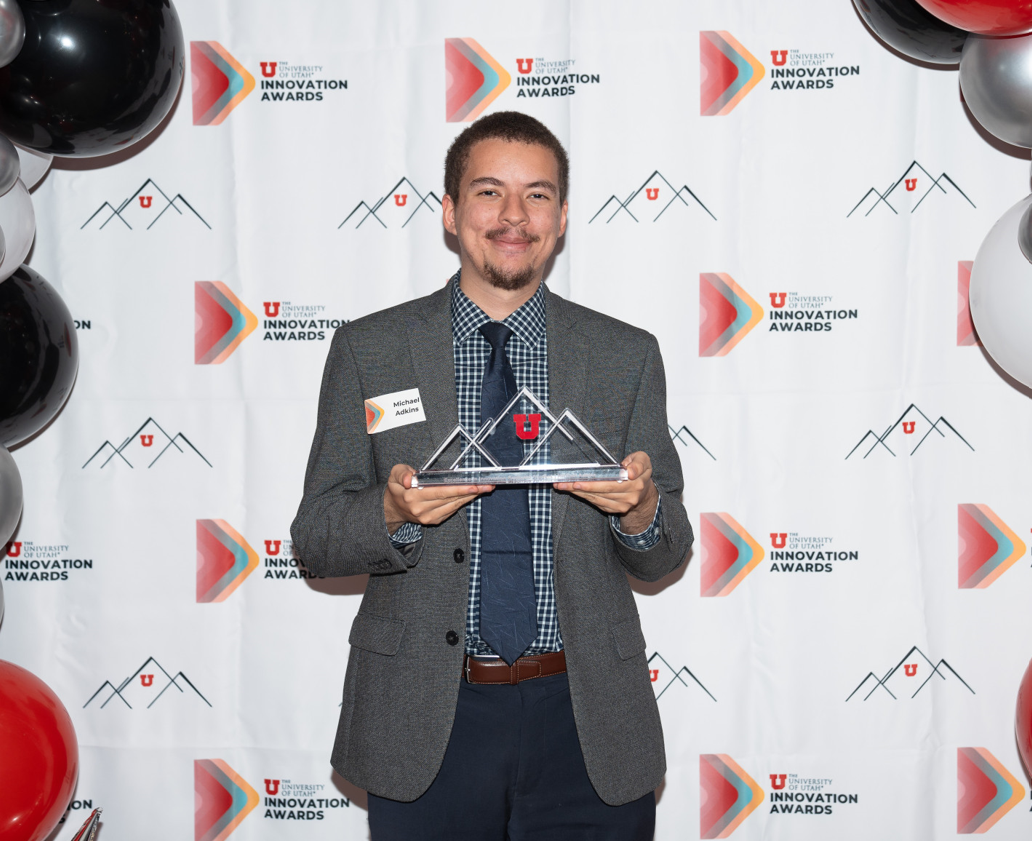
Congrats also to Michael Adkins, Monika Buczak, and Nate Toth for winning the “Best in Engineering” Award. They won $5,000 for their work on the Electronic Grip Gauge. Michael and Monika were student ambassadors for the University of Utah ECE and BME departments, respectively.

Dr. Jacob George Awarded the Outstanding Undergraduate Research Mentor Award

Dr. Jacob George and his Utah Neurorobotics Lab was recently awarded the Outstanding Undergraduate Research Mentor Award. Thank you to all the fabulous undergraduate researchers in our group whose collective achievements made this award possible. We’ve had 42 undergrad fellows in the lab, who have collectively achieved 31 co-authored abstracts, 21 first-author abstracts, 18 co-authored manuscripts, 5 first-author manuscripts, and 57 competitive research fellowships, totaling $385,299.

A special thanks also to all of the graduate student mentors, who provide the critical day-to-day mentorship and training for our undergrads; this award really wouldn’t be possible without them. It’s great to see our lab working together to create a pipeline from K-12 outreach, to high school interns, undergraduate researchers, and graduate students. Thank you all for your many contributions to our research and team.

Abby Citterman Receives Several Awards at 50th Academy Annual Meeting & Scientific Symposium

Abby Citterman, a member of the NeuroRobotics Lab since 2020, a recent graduate of Biomedical Engineering at the U, and a graduate student at Northwestern University Prosthetics-Orthotics Center, attended the 50th Academy Annual Meeting & Scientific Symposium last week with the American Academy of Orthotists & Prosthetists. There, she was awarded the Women in O&P Research Award, sponsored by Össur, along with a $1,500 honorarium, for her research titled Transcutaneous Electrical Nerve Stimulation at the Wrist as a Method to Restore Sensory Feedback for Individuals with Partial Hand Amputation. Abby was also awarded first place in the poster competition for her capstone research project at Northwestern University, titled Do Clinical Assessments of Upper-Limb Prosthesis Users Sufficiently Capture All Dimensions of Anatomical Hand Function?

Congratulations Abby for these prestigious awards!