Spotlight on Fredi Mino: Inspiring the Next Generation of Bioengineers

Our lab is excited to share that Fredi is featured in a new online educational module created for middle school students through University of Utah Health and the Genetic Science Learning Center.

The module introduces students to bioengineering through the lens of prosthetics, and our team partnered with the Genetic Science Learning Center to help shape the content. As part of the project, Fredi appears in several videos, guiding viewers through the lab and talking about his path in engineering and prosthetics research.

The series also includes extensive b-roll footage from the Craig H. Neilsen Rehabilitation Hospital (NRH) shared spaces and highlights many of the researchers who work there, giving students an inside look at what it’s like to work in a modern rehabilitation and bioengineering environment.

You can explore the module here:
Bioengineering & Prosthetics – Working in a Lab
https://learn.genetics.utah.edu/content/careers/lab/

Our Work Featured in KSL Documentary A Higher Purpose

We’re honored to share that our lab’s work was recently featured in the KSL TV documentary “A Higher Purpose,” which highlights how Utah’s universities are tackling some of the world’s most pressing challenges through research, innovation, and service.

The documentary explores projects across the state that are improving lives both locally and globally — from advancing public health and pioneering new technologies to promoting social equity and protecting the environment. Among these transformative efforts is our lab’s contribution to the development of the LUKE arm, a next-generation prosthetic designed to restore natural movement and sensation to individuals with limb loss.

Our team’s work on neural interfaces and human-machine integration is a key part of this groundbreaking technology. By connecting the human nervous system directly to advanced prosthetic systems, we aim to make devices that move and feel like a biological limb — helping users regain not just function, but independence and quality of life.

We’re proud to stand alongside other innovators in Utah’s academic community working toward a higher purpose: using science and technology to improve the human condition.

A Higher Purpose

BIOS Named 2025 Innovation Awards Honoree

We’re proud to announce that BIOS, a company that spun out of our lab, has been named an Emerging Honoree in the Healthcare & Life Sciences category of the 2025 Utah Business Innovation Awards. This annual recognition celebrates the groundbreaking companies and technologies shaping Utah’s future — and BIOS’ inclusion highlights how research born in our lab is transforming lives beyond the university walls.

BIOS is pioneering a Universal Neural Interface that intercepts, captures, and edits neural signals — creating a bridge between the human nervous system and advanced prosthetic devices. This breakthrough technology addresses a critical challenge in prosthetic adoption: many users abandon devices due to limited control or lack of sensory feedback. BIOS’ innovations are designed to change that, making prosthetics that move and feel like a biological limb.

The company’s recognition is more than just an award — it’s a testament to the power of research translation and the impact of collaborative innovation. What began as an ambitious idea in our lab has grown into a technology with the potential to transform the lives of people with limb loss and neurological conditions.

We congratulate the BIOS team on this well-deserved honor and look forward to continuing our shared mission of advancing human-machine integration to improve quality of life.

🏆 Read the full announcement on Utah Business.

🔬 Neurorobotics Lab Students Present at CNI Symposium!

We’re proud to share that several Neurorobotics Lab students presented their research at this year’s Undergraduate Research Symposium, held at the University of Utah Alumni House. Representing the Center for Neural Interfaces (CNI), our students delivered an impressive lineup of posters, covering topics from stroke rehabilitation to advanced electrical stimulation and sensory feedback systems.

🎓 This year’s presenters included:
Lily Nygard, Christie (CJ) Knowles, Shriya Nedumaran, Hana Habib, Emmanuel Attah, Jerry Zheng, Lilith Wright, Harsha Pillarisetti, and Hunter Taggart.

Their work highlights the innovative, cross-disciplinary research happening in the Neurorobotics Lab—and we’re thrilled to see their contributions recognized at a university-wide level.

👏 Congratulations to all our presenters! Your dedication and creativity continue to push the boundaries of neuroengineering.

[

Connor, Monika, & Abby pass Ph.D. Research Proposals!

Congrats to three of our Ph.D. students for passing their Research Proposals! This two-part milestone requires a written and oral presentation of the student’s dissertation plan. Students must demonstrate adequate preparation to begin independent research per their supervisory committee. They must be well-versed in the fundamentals, have sophisticated familiarity with the primary literature in the proposed area of research, and demonstrate an ability to design and effectively communicate a competent, sound research plan.

Congrats, Connor, Monika, and Abby, on completing this major milestone!

Connor Olsen, Electrical and Computer Engineering: “Optimizing Electrode-Skin Interfaces and Evaluation Metrics to Improve Myoelectric Prosthetic Use”
Monika Buczak, Biomedical Engineering: “Intuitive, Myoelectric Control of Assistive Devices”
Abby Harrison, Biomedical Engineering: “Leveraging Transcutaneous Stimulation to Provide Sensory Feedback after Limb Amputation”


Rehab Week & ICORR 2023

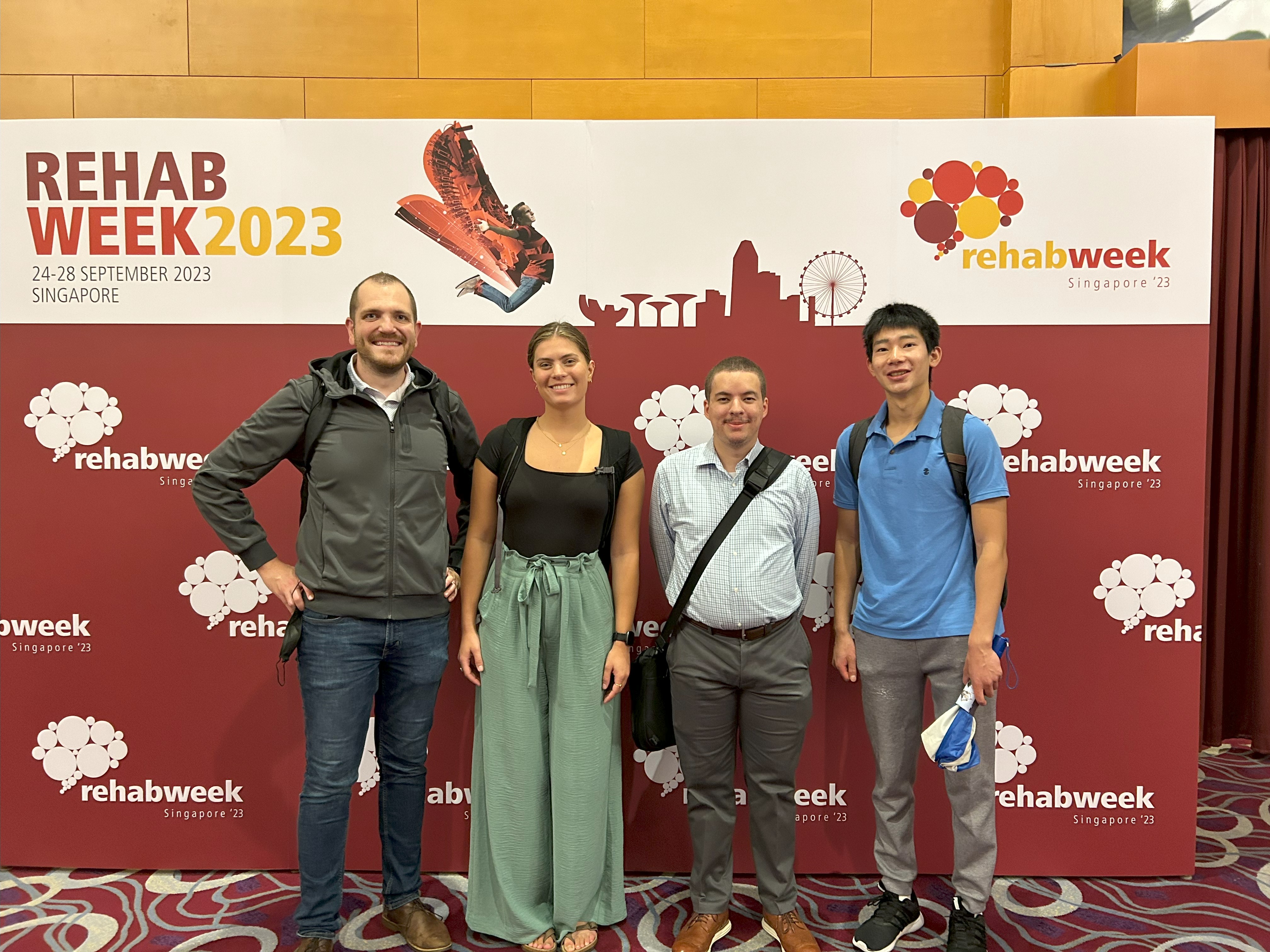
On September 24-28, many members of the lab attended Rehab Week 2023 in Singapore to present their work at the International Consortium for Rehabilitation Robotics (ICORR). This meeting is sponsored by both the IEEE Robotics & Automation Society (RAS) as well as Engineering Medicine & Biology Society (EMBS). Rehab Week included simultaneous meetings from nine different physical rehabilitation and rehabilitation technology societies. Attendees participated in one day of conference workshops before the remaining four days of talks and presentations. In their free time, attendees explored Singapore’s famous hawker food centers, botanical gardens, and diverse cultural neighborhoods!

Lab alumnus Aaron Wang presented an impressive podium talk on his paper titled “Correcting Temporal Inaccuracies in Labeled Training Data for Electromyographic Control Algorithms.”

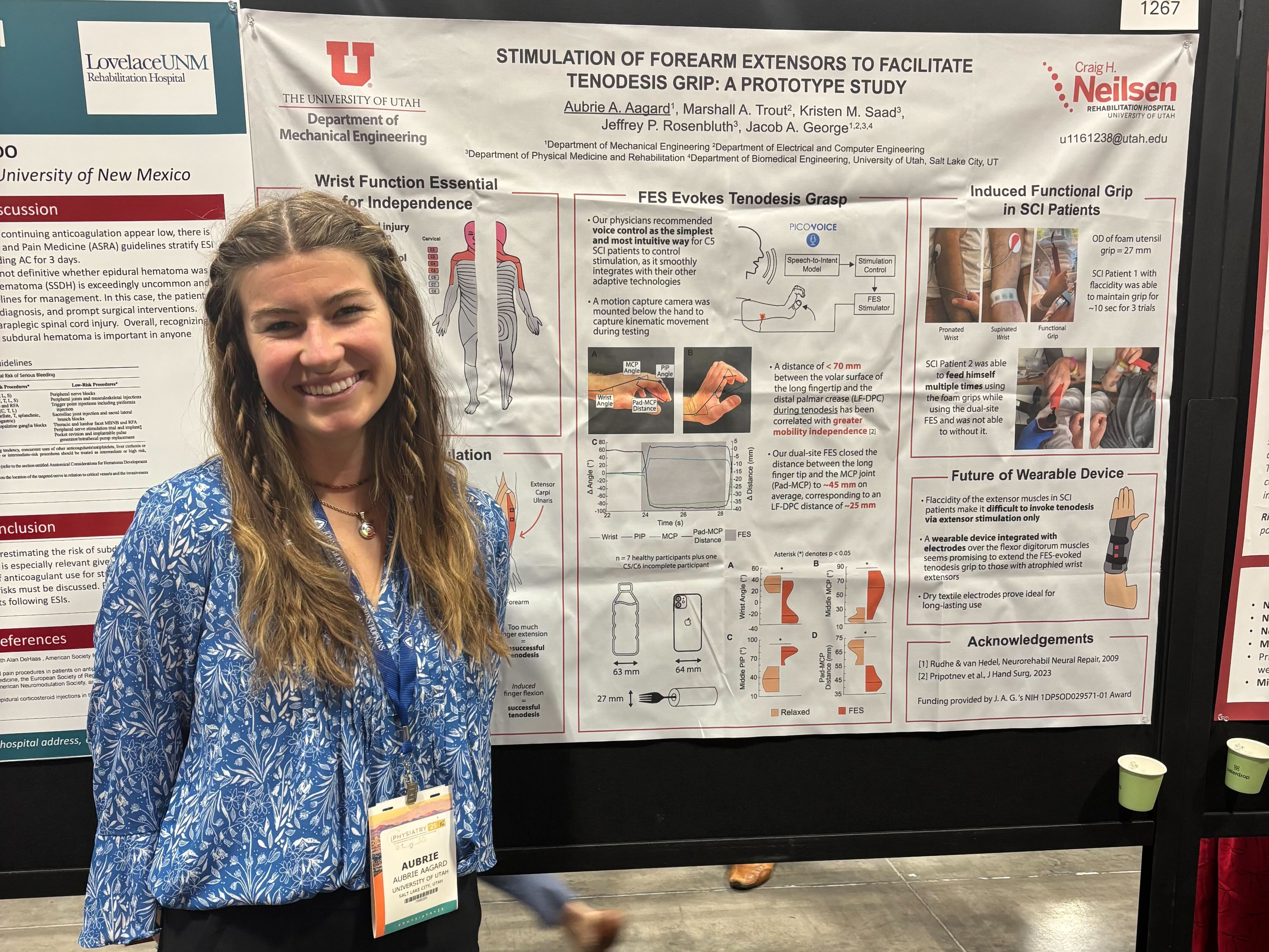
Ph.D. students Michael Adkins, Monika Buczak, and Connor Olsen each presented posters on their papers of the following titles:

  • Adkins: “Automated Quantifiable Assessments of Sensorimotor Function Using an Instrumented Fragile Object”
  • Buczak: “Intuitive, Myoelectric Control of Adaptive Sports Equipment for Individuals with Tetraplegia”
  • Olsen: “Wrist EMG Improves Gesture Classification for Stroke Patients

Congrats to Monika for passing the BME Ph.D. Qualifying Exam!

Congratulations to Monika Buczak for passing the biomedical engineering qualifying exam in neural engineering! As a part of the BME Ph.D. program, students must demonstrate expertise in the subject matter within their track specialization (e.g., neural engineering). After completing the relevant coursework, they meet this requirement by passing an extensive 8-hour written qualifying exam. This is a long and grueling exam, but also marks Monika’s final requirement to earn her milestone M.S. degree in Biomedical Engineering!

Society for Neuroscience 2022

November 12-16, 2022 our lab attended the annual Society for Neuroscience (SfN) meeting in San Diego, CA! SfN is a very large international conference covering all aspects of neuroscience research. The conference was a great success for the lab, featuring one virtual and five in-person poster presentations. Additionally, PhD student Caleb Thompson was featured in a special presentation session for Trainee Professional Development Award (TPDA) winners. See presentation titles below:

Monika Buczak (BME Ph.D. Student): “Electronic Grip Gauge (EGG): Tool to Assess Sensorimotor Interplay in Regulation of Fine Hand Control”
Abigail Harrison (BME Undergraduate Student): “Transcutaneous Wrist Stimulation for Haptic Feedback from the Hand in Virtual and Augmented Reality”
Danielle Lopez (Neuroscience Ph.D. Student): “Utilizing EMG for Stroke Diagnostics: Identifying Metrics that Indicate Degree of Spasticity”
Connor Olsen (ECE Ph.D. Student): “Electromyographically Controlled Prosthetic Wrist Improves Dexterity and Reduces Compensatory Movements without Added Cognitive Load”
Caleb Thompson (BME Ph.D. Student): “Proportional Electromyographical Control of a Bionic Arm in Participants with Chronic Hemiparesis, Muscle Spasticity and Impaired Range of Motion”
Marshall Trout (ECE Ph.D. Student): “Design and Validation of a Low-Cost Noninvasive Neural Stimulator for Functional Electrical Stimulation of Peripheral Nerves and Muscles”

Utah NeuroRobotics Lab at Hi-GEAR Summer Camp

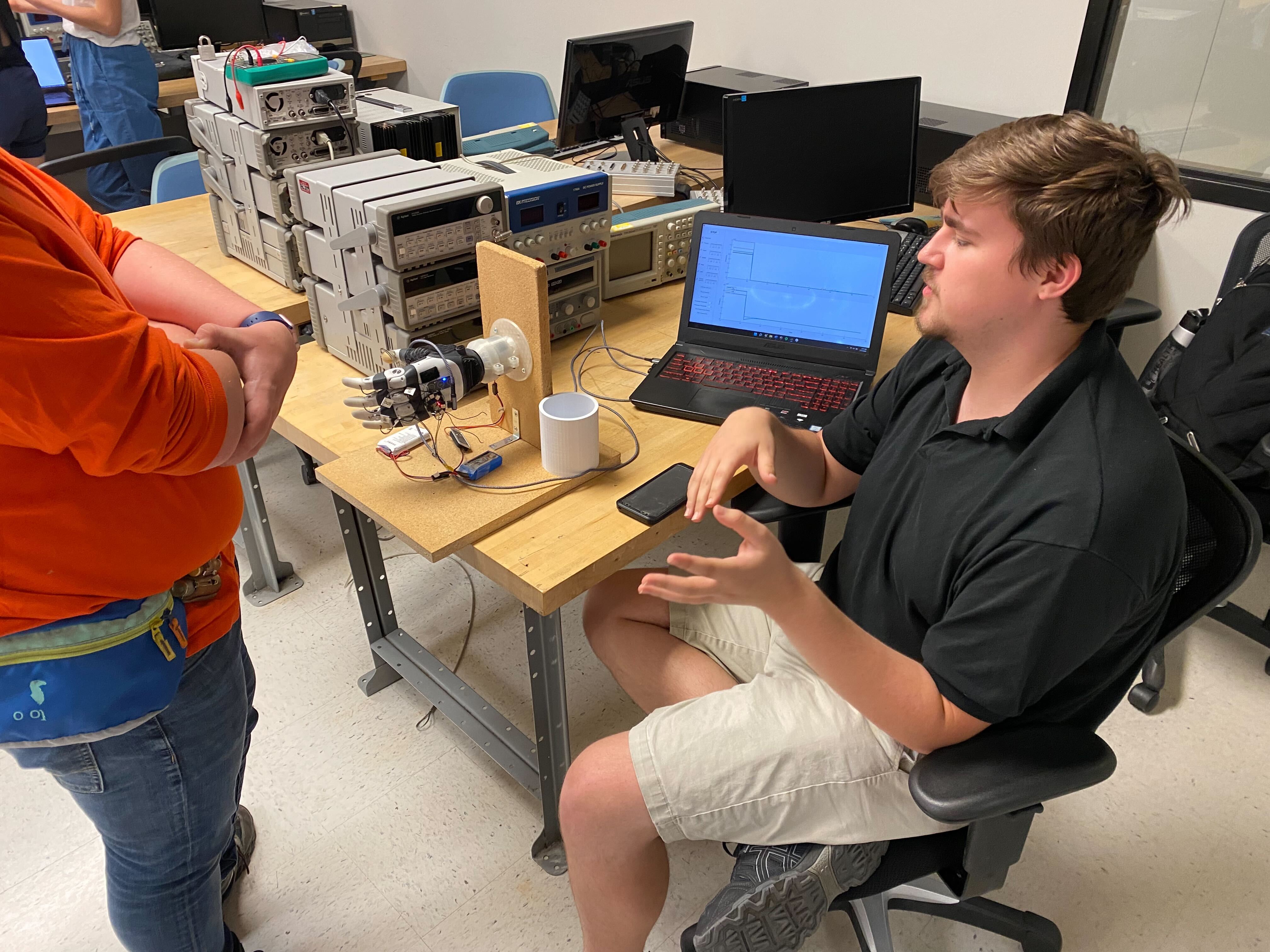
This week, about two dozen high school students from across the country participated in the College of Engineering’s Hi-GEAR Summer Camp. The camp celebrates women in engineering and exposes the students to various engineering and computer science topics, projects, and careers. Utah NeuroRobotics Lab members held a showcase of many current projects, including exoskeletons, bionic arms, EMG control methods, wearable sensors, and dexterity assessments. The attendees witnessed first-hand the role of electrical engineering, biomedical engineering, computer science, neuroscience, and more from our lab.