Biologic Input Output Systems (BIOS), a startup spun out of the Utah NeuroRobotics Lab, has been recognized as an Emerging Company in the Healthcare & Life Sciences category of the Utah Business Innovation Awards. The company’s Universal Neural Interface builds intuitive connections between the brain and advanced robotics to help people with limb loss regain natural movement and sensation, translating decades of University of Utah research into real-world impact. Read more about BIOS and the three University of Utah startups honored in this year’s awards here.
BioHive Features BIOS–U of U Collaboration on Bionic Sensation
BioHive recently highlighted Jacob A. George, Chief Scientist at Biologic Input Output Systems (BIOS), discussing how their Universal Neural Interface is helping people with limb loss regain both movement and real, emotional sensation—often for the first time in decades. In a recent LinkedIn post featuring a video interview, BioHive showcases how BIOS is working with the University of Utah and the NeuroRobotics Lab to engineer advanced prosthetic limbs that reconnect patients with the world around them.
AI & Bionics: Utah NeuroRobotics Lab Featured in U of U AI Story
The University of Utah’s Office of Artificial Intelligence recently highlighted the Utah NeuroRobotics Lab for its groundbreaking work using AI to design bionic devices that restore movement and sensation for people with neuromuscular impairments. Led by Solzbacher-Chen Endowed Professor Jacob A. George, the lab bridges engineering, medicine, and advanced AI to create prosthetic and assistive technologies that improve independence and quality of life. Read the full feature here.
Pioneering the Future: Transformative Technologies for a Healthier World
This feature article from University of Utah Health highlights the NeuroRobotics Lab’s groundbreaking work on the LUKE Arm—an advanced prosthetic that restores both movement and sensation by connecting directly to the nervous system.
Inside the Future of Neurotech: Touring the BIOS Lab at the University of Utah
BioUtah recently toured the groundbreaking Biologic Input Output Systems (BIOS) Lab at the Craig H. Neilsen Rehabilitation Hospital—where cutting-edge neurotechnology, AI, and robotics converge. With innovations like the LUKE Arm, BIOS and the University of Utah’s NeuroRobotics Lab are redefining what’s possible in prosthetic mobility and sensory feedback. Joined by key partners and policymakers, this visit highlighted Utah’s leadership in life-changing medical innovation.
Closing the Gap: Making Advanced Neuroprosthetics Accessible to All
In a recent Financial Times article, the LUKE Arm and other AI-powered prosthetics were spotlighted as groundbreaking yet financially out of reach for many amputees. At the NeuroRobotics Lab, we recognize this challenge—and are committed to driving down costs while pushing the boundaries of human–machine integration. Our work isn’t just about innovation—it’s about ensuring life-changing technology becomes truly life-accessible.
New publication in the Journal of NeuroEngineering and Rehabilitation!
A paper led by Caleb Thomson was recently published in the Journal of NeuroEngineering and Rehabilitation. The paper is titled: “Proportional myoelectric control of a virtual bionic arm in participants with hemiparesis, muscle spasticity, and impaired range of motion” and was coauthored by Fredi R Mino, Danielle R Lopez, Patrick P Maitre, Steven R Edgley and Jacob A George.
This project investigated the ability of stroke patients with hemiparesis to use proportional myoelectric controls.
Michael Adkins Passes Thesis Proposal
Congratulations to Michael Adkins for passing his Electrical Engineering thesis proposal! Michael Adkins developed the Electronic Grip Gauge (EGG), a new kind of device to help assess and rehabilitate the hand function of those with neurological deficits. Michael’s PhD research will focus on using this device with hemiparetic stroke patients to determine its efficacy as an assessment and rehabilitation tool.
Michael Adkins Receives 2024 “Excellence in Innovation Graduate Student” Award
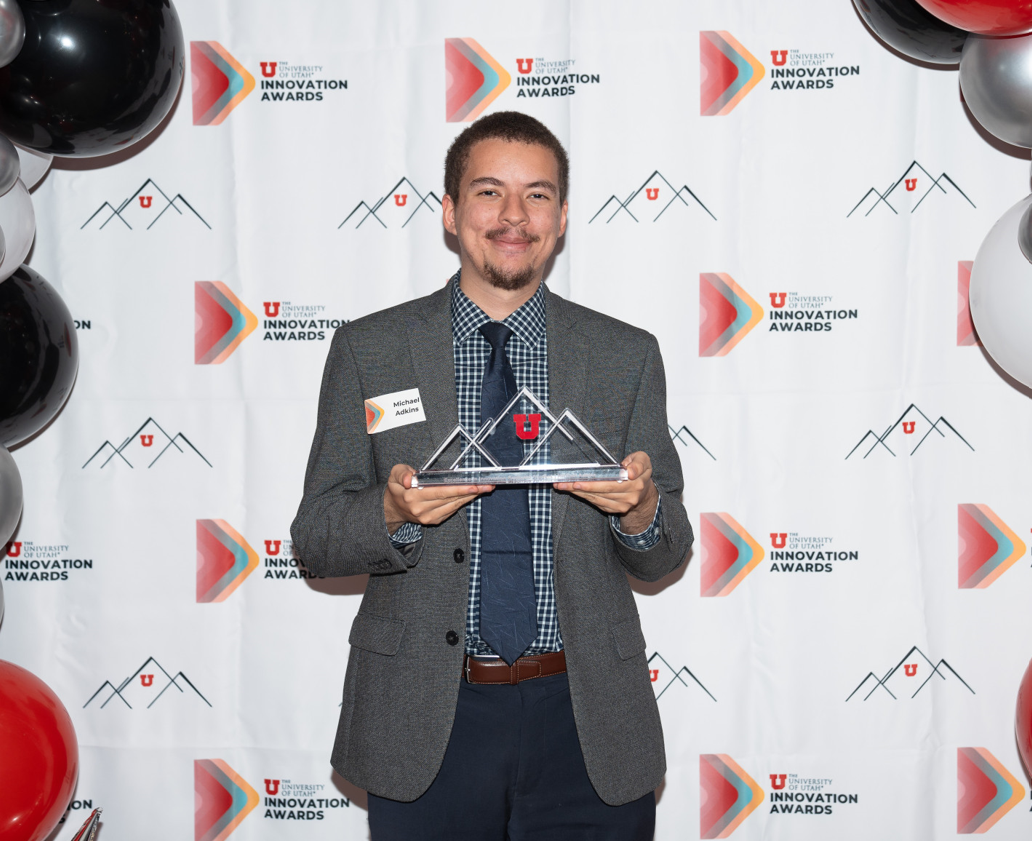
Congratulations to Michael Adkins on being awarded the University of Utah’s 2024 “Excellence in Innovation Graduate Student” Award at this years Innovation Awards. Michael Adkins was the sole awardee of this years award which recognizes a graduate student who has had an exceptional commitment to the development and translation of new technologies, devices, and innovations.
https://technologylicensing.utah.edu/news-events/university-of-utah-announces-2024-innovation-awards-recipients
“Michael Adkins exemplifies the intersection of clinical, business, engineering and scientific innovation. A standout M.D.-Ph.D. student in the Utah NeuroRobotics Lab, Adkins has earned multiple accolades, including an NIH diversity fellowship, a $50,000 NSF I-Corp grant, and $51,000 in business competition awards. His research has led to patents and multiple research articles, is not only scientifically rigorous but also demonstrates commercial viability and immediate clinical impact. Adkins’s ability to immerse himself in customer discovery and entrepreneurial competitions while developing groundbreaking technologies positions him as a rising leader in healthcare innovation.”

Michael Adkins Selected to Advise the NIH NICHD Professional Development Planning Group
Congrats to Michael Adkins for being selected as one of three advisors for the NIH NICHD professional develop planning group. Michael will be advising NIH program staff on professional development programs, info sessions, and workshops for trainees in biomedical research. Through this unique experience he will network directly with NIH program officers, gain exposure to NIH processes, opportunities, and careers, and enhance the way NIH supports trainees. Congrats Michael!